When the beverage industry talks about sustainability, the conversation usually starts with what is inside the bottle: ingredients, water use, energy in production. Yet a large share of the environmental cost of a drink has nothing to do with the liquid itself. It comes from the glass, aluminium and plastic that contain it, and from the trucks, ships and warehouses that move it.
For an industry under growing regulatory and consumer pressure, packaging and logistics are becoming the most important levers for real impact.
The hidden footprint of packaging
Life-cycle analyses consistently point to packaging as one of the largest sources of emissions for fermented beverages. An industry whitepaper on packaging formats found that packaging accounts for around 40% of the carbon footprint of a typical brewed beverage, more than raw materials (22%), refrigeration (18%) or manufacturing (9%) (Thielmann whitepaper, 2022).
The reason is simple. Single-use glass and aluminium are energy-intensive to produce, heavy to transport and, in many markets, poorly recovered after use. Every bottle and can is manufactured, filled, shipped, refrigerated and discarded, often to deliver a single serve.
Moving water across the world
The second hidden cost is logistics. Most beverages are overwhelmingly water. Shipping finished drinks means moving that water, along with its packaging, across long and complex supply chains: from the plant to distribution centres, from warehouses to retailers and venues, and in many cases across borders.
The consequences add up quickly:
- More trucks and containers for the same number of servings.
- Higher fuel use and emissions per litre delivered.
- Larger warehouses and cold rooms to store heavy, bulky finished product.
- More breakage and expiry, which turns into waste before a single serve is poured.
Regulation is raising the bar
Governments are moving from voluntary commitments to binding rules. The European Union’s Packaging and Packaging Waste Regulation entered into force in February 2025 and applies from August 2026. It requires all packaging to be recyclable by 2030 and introduces reuse targets for beverage packaging (Baker McKenzie, 2025).
Latin America is following the same path. Colombia’s extended producer responsibility framework for packaging, established by Resolution 1407 of 2018, requires producers to progressively increase the recovery of the packaging they place on the market, reaching 30% by 2030 (vLex Colombia). For beverage companies, packaging is no longer only a design decision. It is a compliance and cost issue.
From optimizing the old system to redesigning it
Lighter bottles, recycled content and better routes all help. But they optimize a model that still depends on moving finished, packaged liquid over long distances. The bigger opportunity is to change the model itself.
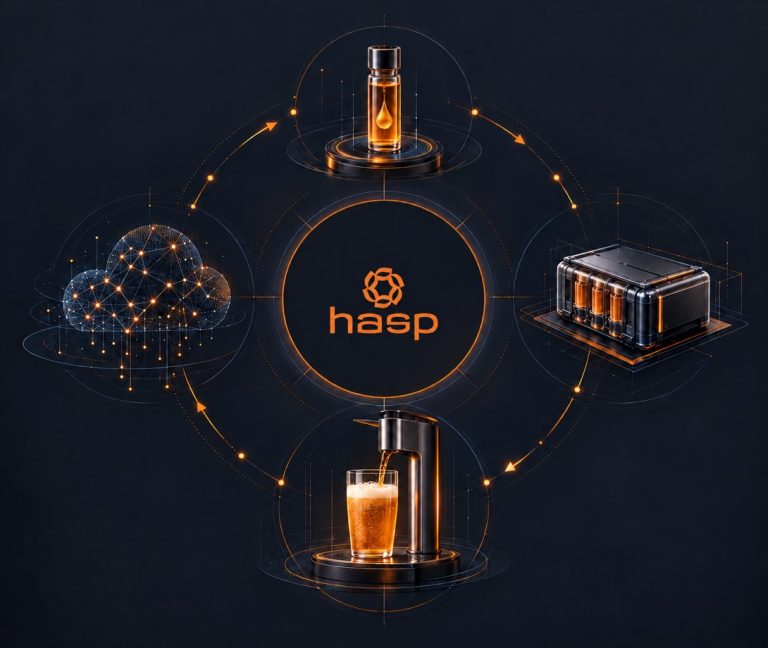
That is the principle behind HASP Global’s technology. Instead of transporting finished beverages, HASP transports a high-quality concentrate and reconstitutes fresh beverages at the point of consumption, using connected dispensers and local water. By design, this approach delivers:
- Up to 92% less packaging material, replacing single-serve containers with compact, high-yield consumables.
- Up to 80% less logistics volume, because the water is no longer shipped.
- Up to 75% less water used in production.
- Around 50% lower carbon footprint across the value chain.
Because every unit is connected to HASP Cloud, operators can also monitor consumption, anticipate demand and reduce product loss, turning efficiency into a measurable, everyday practice rather than an annual report.
Sustainability that pays for itself
The strongest argument for reducing packaging and logistics is that it aligns environmental and financial outcomes. Fewer materials, lighter shipments and less waste mean lower costs for producers and operators, at the same time as they reduce emissions and regulatory exposure.
The beverage industry does not need to choose between growth and responsibility. It needs infrastructure that makes the efficient choice the default one.
Interested in how HASP technology can reduce the footprint of your beverage operation? Talk to our team